
Practical Life Should Be Practical
Dr. Montessori understood that children are powerfully drawn to imitate the people around them. They watch us prepare food, wash dishes, sweep the floor, care for plants, dress ourselves, and maintain our homes. They do not simply want to pretend to participate in this life. They want to become capable of participating in it.
But wanting to imitate someone does not mean that you have the ability to do what they do. I can imitate Simone Biles all day long, but that does not mean I can actually perform any of her gymnastics skills. In the same way, a young child may watch an adult pour a drink, peel a vegetable, wash a table, or sew on a button, but observation alone does not give the child the coordination required to complete that activity successfully.
Children need opportunities to develop the skills necessary to do the things they see happening around them. This is the foundation of Practical Life.
Practical Life and Adaptation
Adaptation underpins the needs and goals of childhood. The child is working to understand the world, become part of it, and learn how to function within the particular time, place, family, and culture into which they were born.
Independence is an important part of this process, but independence is not the final goal in itself. It is one of the tools of adaptation. We help children become independent so that they can participate more fully in their communities, care for themselves and their surroundings, communicate their needs, and act with increasing confidence and competence.
Practical Life is one of the principal ways we support this process. It gives the child the skills needed to participate in everyday life. Through real activity, the child develops coordination, concentration, sequencing, confidence, and control of movement. At the same time, the child learns something even more significant: I know how things are done here, and I am capable of contributing.
This is why Practical Life activities in both the home and the classroom should reflect the child’s actual life.
When an Activity Misses the Point
It is easy to look at Practical Life primarily as a collection of exercises for developing isolated skills. We may identify a skill such as tonging, squeezing, twisting, scrubbing, or strengthening the hands and then invent an activity that allows the child to repeat that movement.
The problem is that the resulting activity may no longer be practical or connected to real life.
Take transferring pom-poms with tongs. The child may be developing coordination and learning to control the tongs, but when would anyone ordinarily use tongs to transfer pom-poms? The activity practices a movement, but it does not help the child imitate something meaningful from daily life.
Seasonal activities can create the same problem. Scrubbing pumpkins may provide practice using a brush, carrying water, and following a sequence, but do people actually scrub pumpkins as part of preparing or harvesting them? Perhaps there is a real context in which they do, but without that context, it becomes an invented activity built around a seasonal object.
Scrubbing seashells can also be a stretch. If the children have returned from the beach with shells covered in sand, washing them is a sensible activity with a clear purpose. Keeping a permanent shell-scrubbing activity on the shelf simply because shells are attractive is different. The movement may be useful, but the reason for doing it has disappeared.
Practical Life should not mean taking any appealing object, adding water and a brush, and calling it purposeful work.
Participation, Not Pretending
The same principle applies to toy kitchens and pretend cleaning sets. Children may gain something from opening cupboards, carrying objects, moving a toy mop, or acting out familiar routines. Imaginative play has value. However, pretending to clean is not the same as learning how to clean.
The child who is trying to imitate an adult needs access to the real activity. A child-sized broom that genuinely sweeps the floor gives the child information that a toy broom cannot. A real cloth, appropriately sized bucket, and small amount of water allow the child to experience the weight, resistance, coordination, and consequences involved in cleaning.
The goal is not merely to keep the child occupied with something resembling adult work. The goal is to help the child become capable of doing that work.
This does not mean handing a young child full-sized equipment and expecting immediate success. The adult analyzes the activity, isolates its movements, chooses tools the child can manage, and presents each step slowly. The child gains the necessary skills gradually through repeated practice. Over time, what began as collaboration becomes genuine independence.
Preliminary Activities Still Have a Place
Not every Practical Life activity needs to produce a large, visible result. The preliminary exercises intentionally isolate foundational movements the child will need later.
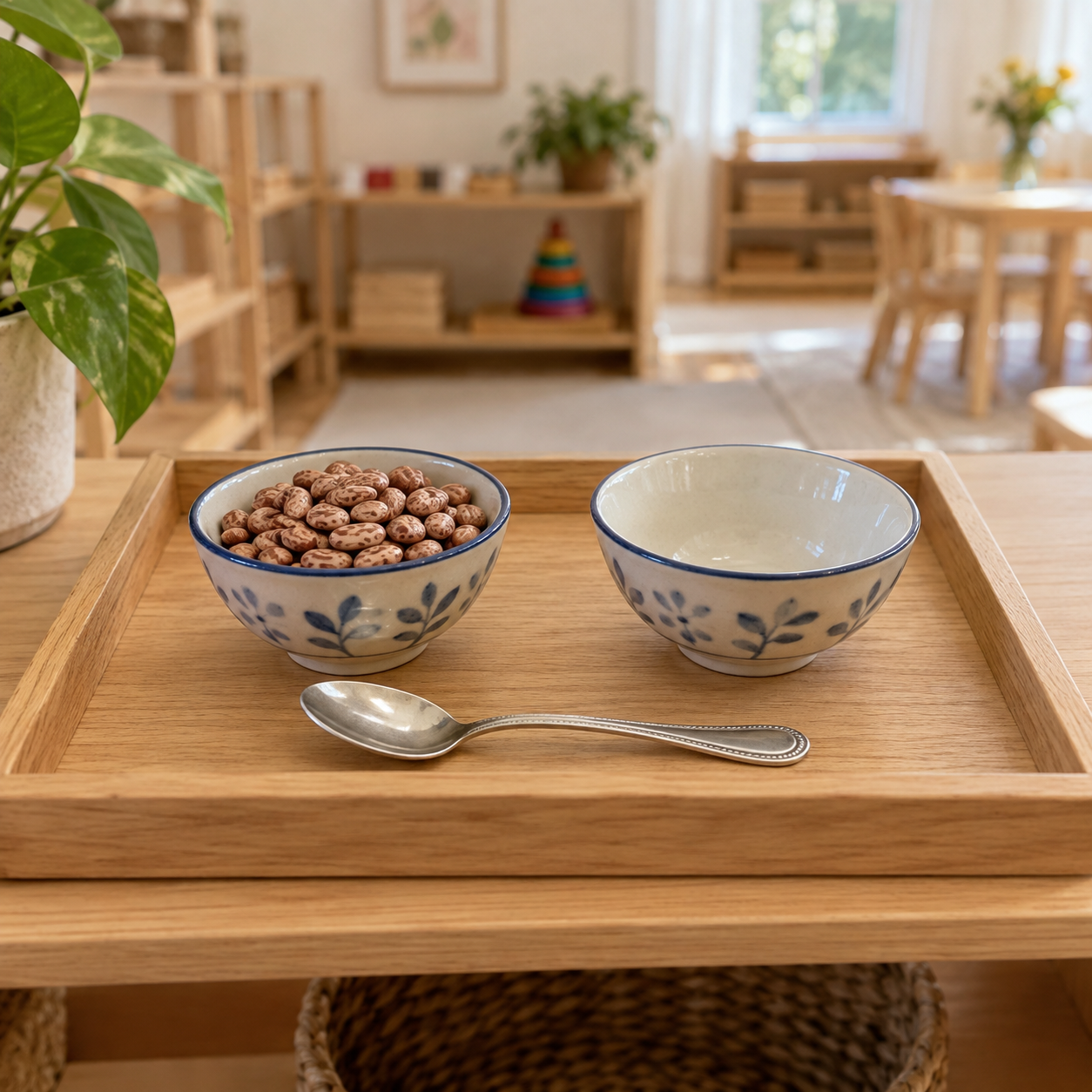
Spooning beans from one bowl to another, for example, does not have the same direct purpose as washing a table or preparing food. Nothing new has been produced, and the beans may end exactly where they began. However, the activity still reflects a movement the child sees in real life. People use spoons to transfer food. People pour water, fold cloths, open containers, carry trays, and use tongs.
These simple activities prepare the child for more complex participation. Their purpose is not imaginary, even when the exercise has been simplified and isolated. They remain grounded in recognizable human activity.
That distinction matters. A preliminary exercise may isolate a skill, but it should still make sense in relation to the child’s real world.
Begin With a Real Need
When creating a new Practical Life activity, we should begin by asking what the child genuinely needs to learn or do. Then we can identify a real activity that provides practice with the necessary movement.
If children need to develop strength and coordination in their arms and hands, we do not necessarily need to place sponges in a salad spinner simply to make them turn the handle. Perhaps they could use a hand grinder to grind coffee beans or spices. They might whisk eggs, operate a small food mill, or turn the handle of another tool that is genuinely used in the community.
If children need practice using tongs, they could transfer pieces of food during preparation or serving. Chestnuts, large pasta, sliced fruit, bread, or vegetables may all provide meaningful opportunities, depending on the classroom and culture.
If they need practice squeezing, they might squeeze a sponge while cleaning a table, wring out a cloth, juice an orange, or use a garlic press during food preparation.
The activity should not be invented around the movement. The movement should be found within an authentic activity.
Reflecting the Child’s Particular Life
There is no universal list of Practical Life activities that belongs in every classroom. Practical Life should look different across countries, cultures, climates, families, and communities because daily life itself looks different.
The foods children prepare, the tools they use, the clothing they fasten, the surfaces they clean, and the ways they care for their environment should reflect what they actually encounter. An activity that is meaningful in one community may be artificial in another.
This requires observation. We need to watch the children, notice what they are trying to imitate, identify where their skills are preventing participation, and offer the missing point of connection. We also need to examine the life happening around them. What work do they see adults doing? What could they participate in if the tools, pace, and sequence were adapted to their abilities?
Children are not asking us to create an imitation of life for them. They are asking for access to life itself.
Practical Life answers that request. It gives children the skills to act on what they have absorbed through observation. It allows them to move from watching to participating, from wanting to help to knowing how to help, and from depending entirely on others to becoming increasingly capable members of their communities.
That is what makes Practical Life so powerful. It is not simply preparation for later academic work, a collection of fine-motor exercises, or an attractive shelf filled with coordinated trays. It is the practical work of adaptation. It helps the child enter the life unfolding around them and gradually claim their place within it.