
Helping Children Choose in the Classroom
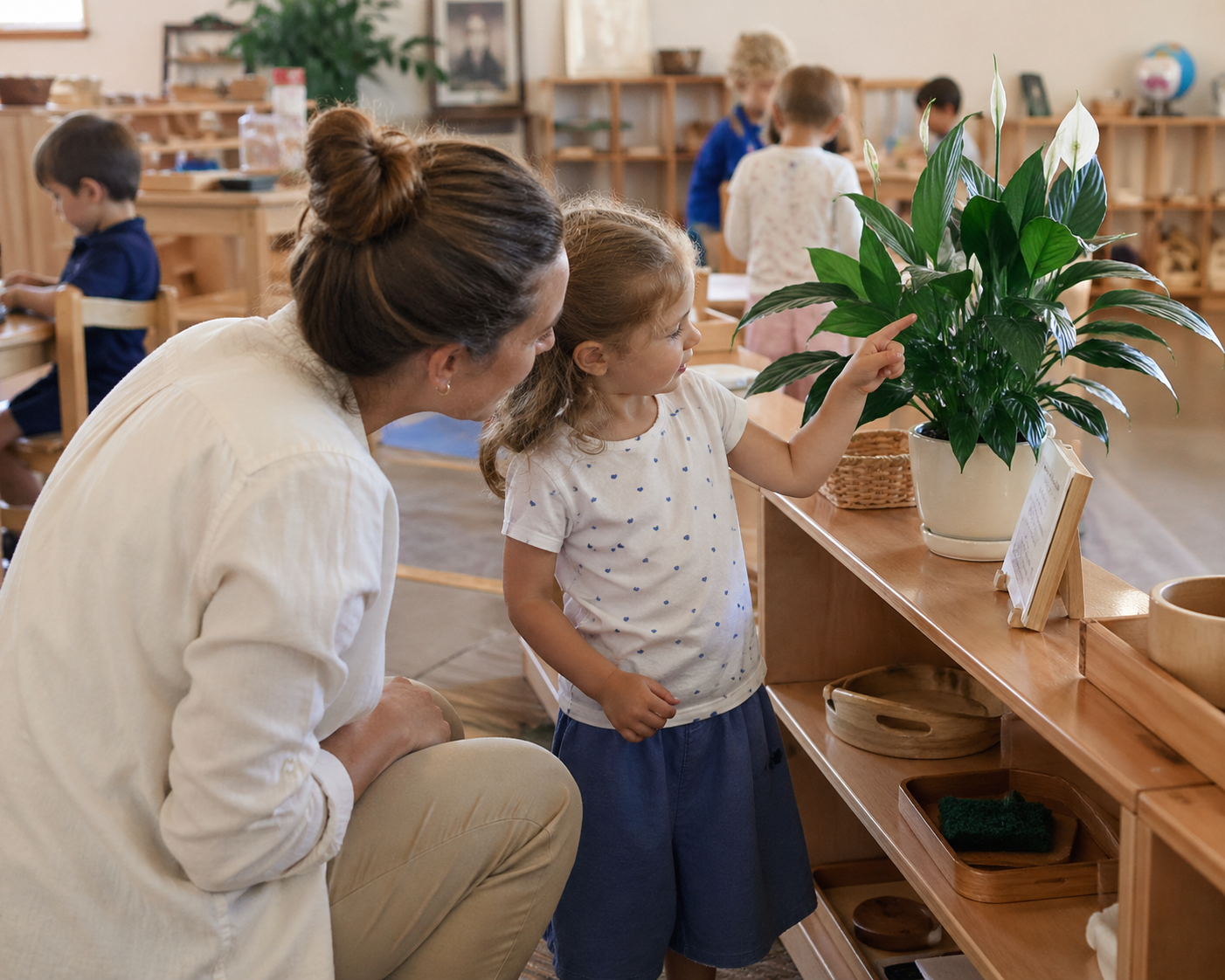
One thing to remember about helping children choose an activity is that we are the bridge between the child and the work. It is our responsibility to present activities in a way that makes them enticing. There is nothing more boring than asking, “Do you want to do this or do you want to do that?” This is something I hear often in classrooms, especially from untrained assistants. We can be more creative than that. Make the material sing. Invite the child in. This is what Maria Montessori encouraged us to do.
Children who wander or habitually avoid work have almost always not had enough, or not the right, presentations. The long-term solution is to return to clear, engaging presentations. But in the moment, some children simply need support to get started. There are a few tools you can use.
One is the walk-around technique. Take the child with you and walk around the room, talking about different activities in the environment. You might say, “We could do silver polishing. I saw on the shelf that Miss Mary brought in a brand-new silver candlestick to polish. We could also do leaf cleaning. Did you notice the peace lily has a new flower coming up? We could clean the leaves to help it grow. We could try the stamp game. I saw Miss Mary gave you a presentation on addition. We could take an addition problem and see if you can do it all by yourself.”
Continue like this as you move around the classroom. Be careful not to ask, “Do you want to do this?” after each option. If you do, the child will likely say no each time. Instead, wait until the end and say, “Why don’t you walk around and choose one of the activities we looked at that sounded interesting to you?” After hearing several enticing options, the child is much more likely to engage.
Sometimes children find it easier to choose when the options are limited. Think about standing in front of a shelf with 100 different kinds of deodorant. It can take ages to decide. It is similar for a child looking around a classroom. If we narrow the options and make them appealing, it becomes much easier.
One way to do this is the limited choice technique. This is especially helpful for younger children who may not yet be able to make consistent choices throughout the morning. You might say, “Would you like to spoon beans from this bowl, or would you like to open all of these boxes and see if you can close them again?” Notice that you are not just naming the activity. “Spooning” or “opening and closing” on its own is not very inviting. Describe the action and the purpose so the child can imagine the experience.
Another option is the “we’re doing this” technique. This narrows the choice even further and can be helpful for younger children or for older children who need more structure in that moment. Here, you choose the activity, but offer choices within it. For example: “We are going to build a tower. Would you like to build it as tall as you can and see how straight it is, or would you like to build it three times and see if you can do it exactly the same way each time?”
In this case, the activity itself is not up for negotiation. What is available as a choice is how the child engages with it. This is always presented in a calm, matter-of-fact way. The invitation comes through how you describe the possibilities.
Another example might be: “We are going to work with the trinomial cube. Would you like to build it outside of the box, or would you like to challenge yourself and try building it blindfolded?”
Often, grounding a child in the practical life area is one of the most effective ways to help them re-engage with the environment.
When a child is wandering, avoiding work, or unable to choose, it is often a sign that they feel a bit disconnected or overwhelmed. Practical life meets them exactly where they are. It is concrete, purposeful, and immediately accessible. There is a clear beginning, middle, and end. The child knows what success looks like.
Practical life also speaks directly to the child’s drive for independence. These are real activities with real outcomes. The table is clean. The plant is cared for. The water has been poured. This sense of completion is deeply satisfying and often helps regulate the child.
You might gently guide a child by saying, “Let’s go check if anything in the classroom needs our help.” Then walk together and notice what could be done. “I see some crumbs on this table. We could wipe it.” Or, “These leaves look a bit dusty. We could clean them.” Or, “This tray is ready for polishing. It’s been waiting for someone to take care of it.”
You are not assigning work. You are inviting the child into a role. The tone is one of purpose and contribution.
For some children, especially when they are feeling resistant, it can help to begin together. Start the activity side by side. Model the first step. Get the hands moving. Often, once the child is engaged, you can quietly step back and allow them to continue independently.
Practical life can also act as a reset. It brings the child back into their body through movement. It offers repetition without pressure. It restores a sense of order both internally and in the environment. After completing a practical life activity, many children are much more able to choose follow-up work in other areas of the classroom.
It is not a step backward. It is often exactly the step the child needs to move forward.