
Tantrums: What’s Really Going On?
This week, I’ve been thinking a lot about emotional regulation. We’ve hit the four-month sleep regression, and man, is my baby May a fussy girl at the moment! Full-on temper tantrums are a ways off still, but the foundations of her emotional regulation and stability are happening now.
From the very beginning, babies rely on co-regulation. Through repeated experiences of being soothed, held, and understood, their nervous system begins to organize itself. Over time, these external experiences become internal capacities.
So when we talk about tantrums later on, we’re really talking about the continuation of this same developmental process.
And it’s made me reflect on how often we misunderstand what’s happening when children do reach that stage.
Tantrums are one of those topics that almost every parent worries about at some point and every teacher has dealt with at least once. They can feel intense, unpredictable, and sometimes completely overwhelming. Especially when they happen in public, or at the end of a long day when your own capacity is already stretched.
But the more I’ve worked with children, and the more I’ve studied development, the more I’ve come to see tantrums differently.
Not as something to stop necessarily, but more as something to understand and support.
So, what is a tantrum, really?
A tantrum is not usually “bad behavior.” It’s an expression of an unmet need from a child who does not yet have the ability to regulate their emotional state. From a developmental perspective, this aligns closely with what we see in early childhood neuroscience. Young children have an immature prefrontal cortex, the part of the brain responsible for impulse control, planning, and emotional regulation. Research shows that this area is still developing well into early adulthood (Casey et al., 2005).
So when something feels overwhelming, frustrating, or disappointing, children don’t yet have the neurological capacity to manage that experience calmly. Instead, the feeling comes out physically: crying, screaming, throwing, or collapsing.
From the outside, it can look dramatic or disproportionate. But from the inside, it is a genuine experience of overwhelm.
A quick look at the brain
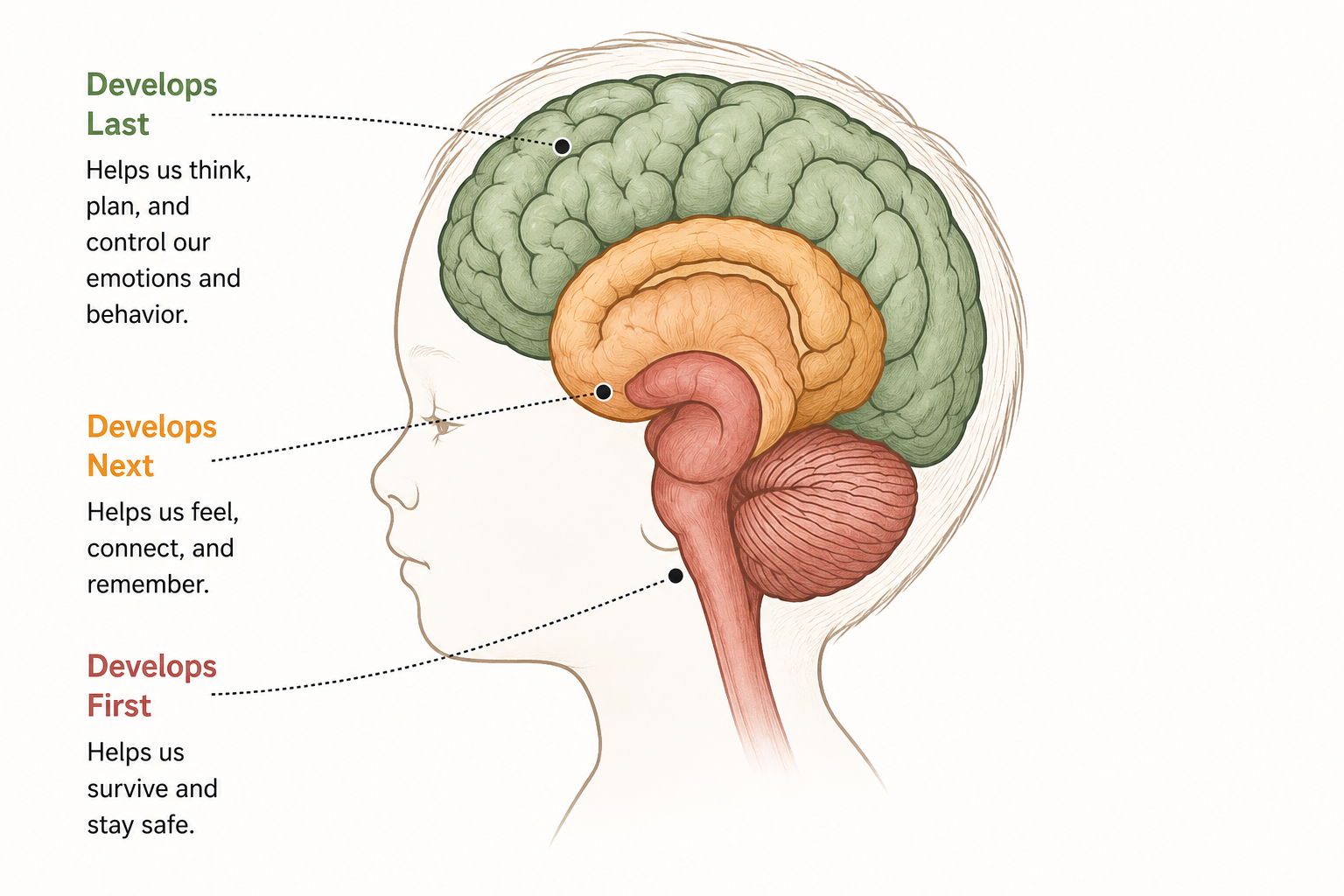
Development follows a bottom-up trajectory.
One of the most helpful frameworks comes from Dan Siegel, who describes the brain as having an “upstairs” and “downstairs” system.
The downstairs brain includes the brainstem and limbic system, responsible for survival responses and strong emotions like fear and anger.
The upstairs brain includes the prefrontal cortex, responsible for reasoning, empathy, and self-control.
Development follows a bottom-up trajectory. The emotional and survival systems are highly active early on, while the regulatory systems are still under construction.
When a child is overwhelmed, the amygdala, the brain’s alarm system, becomes activated. Research in affective neuroscience (LeDoux, 2000) shows that this activation can temporarily inhibit access to higher-order thinking.
In simple terms, the “staircase” between emotion and logic is offline.
So in the middle of a tantrum, your child quite literally cannot access reasoning. They are not choosing chaos, they are overwhelmed by it.
Why this matters
When we don’t understand this, we tend to respond with logic:
“Use your words.”
“Calm down.”
“That’s not a big deal.”
But these responses rely on brain functions that are not available in that moment.
This is why tantrums often escalate when we try to reason too soon.
Research in interpersonal neurobiology emphasizes that emotional regulation develops through relationships, not instruction. Children first need to feel regulated before they can think clearly.
Connection before correction
This is where Montessori aligns beautifully with modern neuroscience.
Dr. Maria Montessori emphasized the role of the adult not just as a guide of the environment, but as a model of behavior and emotional regulation. The child absorbs not only language and movement, but also emotional patterns.
This idea is supported by attachment research from John Bowlby and Mary Ainsworth, which shows that children develop secure emotional regulation through consistent, responsive caregiving.
In moments of distress, children are not looking for correction first. They are looking for co-regulation: a calm presence, steady tone, and sense of safety. This is what allows their nervous system to begin settling.
The integration process
The long-term goal is what Dan Siegel calls integration.
Integration means that different parts of the brain are working together. Emotional, logical, and physical systems are connected.
When integration breaks down, we see what looks like “misbehavior,” but is actually a temporary state of disorganization.
Siegel describes this using the “river of well-being.” When we are integrated, we are flowing in the center, flexible, calm, and responsive. On one side is chaos: overwhelm, emotional flooding, loss of control. On the other side is rigidity: inflexibility, power struggles, over-control. Young children move in and out of this state constantly. And our role is to help them return to balance.
Why “quick fixes” don’t work
It can be tempting to distract or resolve the situation quickly. (think of the “Jessica?” trend) And in the short term, that can stop the behavior. But research on emotional development suggests that avoiding or suppressing emotional experiences limits a child’s ability to build long-term regulation skills.
When we consistently step in to remove discomfort, children don’t learn how to tolerate or process those feelings.
Instead, the goal is to support them through the experience.
To help them feel:
“I can feel this… and I can get through it.”
What helps in the moment
When a tantrum happens, the sequence matters.
1. Recognize
This is a brain-based response, not a behavioral choice.
2. Connect
The key is to bring energy down through calm, quiet, simple words, gentle touch, or simply being there.
Use tone, presence, and as simple and little language as possible:
“You’re really upset.”
“You didn’t want to leave.”
Sometimes words do not help. Simply sitting calmly and quietly offering your presence is enough of a connection.
You can offer closeness, perhaps through a hug if your child is open to that during the storm, but many children simply need you to kneel down and calmly wait with them while they go through whatever they need to express.
3. Hold the limit
Emotions are allowed. Not all behaviors are.
“I won’t let you hit.”
“We’re still leaving the park.”
Consistency builds neural patterns over time and helps your child understand over time that this emotional reaction does not lead to you giving in. You are showing them through your strength and leadership that you are there to weather the storm and that that storm will never be strong enough to budge your resolve or your obligation to protect and guide them.
4. Wait
Emotions follow a physiological arc. They rise, peak, and fall.
There is no shortcut through this process.
Your calm presence acts as an external regulator.
After the storm
Once the child is calm, the brain is ready for learning again.
This is when you can reflect and guide.
Helping a child retell what happened supports memory integration and emotional processing. Research shows that narrative building strengthens connections between emotional and language centers in the brain. This aligns with what Siegel calls “name it to tame it,” where labeling emotions helps integrate brain activity.
Simple language is enough:
“You were sad to leave. Then we sat together. Then you felt better.”
Over time, this builds self-awareness and emotional literacy.
A shift in perspective
One of the most important reframes is this: Tantrums are not moments of disobedience.
They are moments of dis-integration. And your role is not to control them. It’s to help your child come back into balance.
A final thought
Growth takes time. For children, and for us!
Research consistently shows that emotional regulation is built through repeated relational experiences, not isolated teaching moments.
Every time you respond with calm, connection, and consistency, you are quite literally shaping your child’s developing brain.
You are building the neural pathways that will eventually allow them to regulate themselves.
So when tantrums happen, instead of asking:
“How do I stop this?”
We can begin to ask:
“What is my child needing right now?”
And,
“How can I support them through it?”
If you’d like to go deeper into this topic, watch my Temper Tantrums: What’s going on in there? talk on YouTube here 👇
https://www.montessoriguide.net/tantrum-link